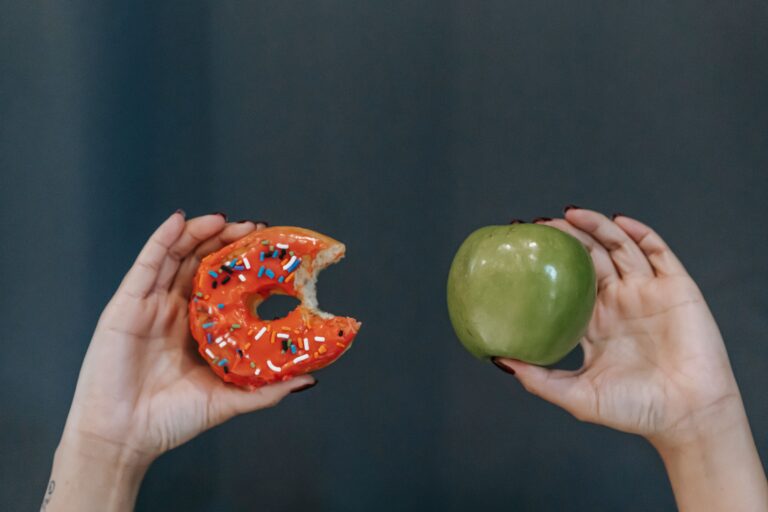
Food Guilt Isn’t About the Food. It’s About Trust.
Most people think food guilt is about the food.
It isn’t.
It’s about trust. And it erodes so slowly that most people don’t notice it happening until they’re standing in front of the fridge, feeling like a stranger to themselves.
The First Crack
It usually starts small. A “should.” A rule you didn’t make but started following anyway. Skip the bread. Earn the dessert. Don’t eat after 8pm.
None of these rules are inherently dramatic. But every time you override what your body is telling you in favor of a rule someone else wrote, you’re sending yourself a quiet message:
“Your instincts can’t be trusted here. Mine can.“
Do that enough times, in enough small moments, and something starts to shift. Not all at once. Gradually. The way a shoreline erodes — you don’t see the tide take it, you just notice one day that the coastline looks different than you remember.
Guilt Is a Symptom, Not the Problem
By the time guilt shows up (the “I shouldn’t have,” the mental replay of what you ate, the compulsion to make up for it), the real damage has already happened. Guilt isn’t the wound. It’s the alarm going off after the wound, telling you a rule got broken.
And here’s the part that matters: the rule was never yours to begin with.
Guilt convinces you the problem is your appetite, your choices, your lack of control. But if you trace it back far enough, the guilt is usually loyalty to an external standard, dressed up as self-discipline.
What Self-Trust Actually Looks Like
Self-trust isn’t the absence of structure. It’s not “eat whatever, whenever, no thought required.” That’s its own kind of extreme, and it’s not what we mean here.
Self-trust is smaller and quieter than that. It’s the ability to feel hungry and believe the hunger. To feel satisfied and believe that, too. To have a slice of birthday cake without an internal committee convening to decide whether you’re “allowed.”
It’s knowing your body is giving you real information, not a threat to be managed.
Most people lost this skill somewhere between childhood and adulthood, usually without ever choosing to. It got traded away, one small rule at a time, in exchange for the promise that control would eventually feel like peace. It rarely does.
How to Stop Food Guilt: Rebuilding Is Slower Than Breaking
Here’s the part nobody wants to hear: trust breaks fast and rebuilds slowly. You didn’t lose it overnight, and you won’t get it back overnight either.
Rebuilding self-trust with food looks less like a plan and more like a practice. It’s noticing a craving without immediately negotiating with it. It’s eating something “off-limits” and observing, with actual curiosity, what happens next. Usually, nothing catastrophic. Usually, just… a meal.
It’s tolerating the discomfort of not having a rule to hide behind, and finding out you’re still okay.
This is slow, unglamorous work. There’s no meal plan that shortcuts it, because the thing being rebuilt isn’t a set of behaviors — it’s a relationship.
You’re Not Undisciplined. You’re Disconnected.
If there’s one reframe worth sitting with, it’s this: the issue was never a lack of willpower. It was a disconnection between what your body says and what you’re willing to believe.
Healing that isn’t about trying harder. It’s about listening again, to a voice you were taught to override.
You don’t rebuild trust by finding a better rule. You rebuild it by proving to yourself, one meal at a time, that you don’t need one.
What This Looks Like in Real Life
It won’t happen overnight. But you’ll start noticing things.
Enjoying dessert at a friend’s birthday, actually enjoying it. Ordering what you want off a menu instead of the salad because it’s “what you should have.” Finishing a meal without running the numbers in your head afterward.
None of these moments look dramatic from the outside. But each one is a small deposit back into the account that diet culture spent years withdrawing from. That’s the whole practice: small, repeated proof that your body’s signals are trustworthy, until believing them stops feeling like a risk.
About the Author

Marisa W. Smith, MDA, RD, CDCES
Marisa is the founder and CEO of Dietitian Group, an insurance-covered nutrition practice based in Nashville offering both in-person and telehealth visits. She created the THRIVE Method™, the philosophy behind how DG approaches nutrition care — sustainable, non-diet, and built for real life instead of restriction. Marisa’s clinical focus is diabetes management and PCOS, and on this blog she unpacks the thinking behind THRIVE — eating that works in real life, without restriction or perfectionism.
Ready to cut through the noise and actually feel good about what you eat?
Work with a dietitian — covered by insurance — to figure out what actually works for your health.
Or come find us on Instagram @dietitiangroup — we promise we won’t make you feel bad about your cooking oil.